The APA Office of Continuing Education in Psychology sponsors continuing education (CE) credit for selected 1-hour sessions offered by APA Divisions and governance groups to promote high-quality educational programming at APA 2027.
If you are submitting a Critical Conversation, Skill-Building Session, or Symposium, your session is eligible to be considered for CE credit. Business meetings, committee meetings, Flash Talks, poster sessions, and social hours are not eligible for CE credit.
Proposals must demonstrate that the session meets the Standards and Criteria for Approval of Sponsors of Continuing Education for Psychologists. We encourage you to review the APA CE Program Criteria for additional assistance.
How to be Considered for CE Credit
Align your session with the Definition of Continuing Education for Psychologists
To meet the definition of continuing education for psychologists, CE Sessions must:
- Be relevant to psychological practice, education and science
- Enable psychologists to keep pace with the most current scientific evidence regarding assessment, intervention, and education as well as important legal, statutory, or regulatory issues
- Allow psychologists to maintain, develop, and increase competencies in order to improve services to the public and enhance contributions to the profession.
CE builds upon a completed doctoral degree in psychology. CE sessions do not take the place of graduate level training and coursework.
Make sure your session focuses on CE-appropriate content
The content of each CE Session must focus on one of the following:
- Application of psychological assessment and/or intervention methods that have overall consistent and credible empirical support in the contemporary peer reviewed scientific literature beyond those publications and other types of communications devoted primarily to the promotion of the approach.
- Ethical, legal, statutory or regulatory policies, guidelines, and standards that impact psychological practice, education, or research.
- Topics related to psychological practice, education, or research other than application of psychological assessment and/or intervention methods that are supported by contemporary scholarship grounded in established research procedures.
Indicate your interest
If your session meets the definition of CE for psychologists, is CE-appropriate content, and you would like to be considered, select “Yes” on the Consideration for CE Credit question in the proposal submission platform.
Provide additional information that address APA CE Standards and Criteria
In addition to submitting your session materials, you will need to provide the following information about your session for consideration for CE credit.
All CE application questions must be completed for your session to be considered for CE credit. Incomplete submissions will be automatically rejected.
Abstract
Describe the general theoretical and/or empirically-based content to be covered in this session. CE programs must be grounded in an evidence-based approach. You can show that your program is credible by citing current (within the past 10 years), relevant peer-reviewed studies and, where appropriate, well-established research or theory in the field. It is up to you to give clear, convincing evidence that your program counts as continuing education for psychologists, in that it improves service to the public and enhances contributions to the profession. The further your topic is from core disciplinary knowledge, the more you need to explain, with evidence, how it meets this definition. A session must be supported by appropriate evidence to qualify for CE; being interesting or timely alone is not sufficient.
Learning Objective
Learning objectives are statements that clearly describe what the learner will know or be able to do as a result of having attended the program. Learning objectives should contain action verbs that describe measurable behaviors. The learning objectives should be appropriate in breadth for a one-hour session and sufficient in depth for the postdoctoral psychologist.
Verbs to consider when writing learning objectives: list, describe, recite, write, identify, compute, discuss, explain, predict, apply, demonstrate, prepare, use, analyze, design, select, utilize, compile, create, plan, revise, assess, compare, rate, critique
Verbs to avoid when writing learning objectives: know, understand, learn, appreciate, become aware of, become familiar with.
"Based on the content of this session, participants will be able to:" is assumed as the leading phrase.
Reference List
Provide at least three complete references, formatted in APA style, that support the session’s content and show that it meets the definition of continuing education for psychologists. References must be published within the last 10 years and align with the session’s learning objectives. Because CE programs must be grounded in an evidence-based approach, references should include peer-reviewed scientific literature. CE programs may also provide information related to ethical, legal, statutory or regulatory policies, guidelines, and standards that impact psychology, and those should be cited.
Instructor Qualifications
Although it is not required that instructors be psychologists, they must have expertise and be competent in the areas in which they teach. Expertise might be demonstrated by some combination of the following: relevant educational experience, such as holding a doctoral degree in psychology, years of clinical experience, publications and/or prior teaching experience in areas relevant to the content being taught. Each presenter listed on the proposal must provide the following information or enter N/A:
- Current Employment Title
- Number of Years in Current Position
- Education Background
- Professional Licensure Status
- Teaching Experience
- Previous Professional Positions.
Full Disclosure and Ethical Considerations
The Presenter must make attendees aware of (verbally or in writing) the accuracy and utility of the materials presented, the resources on which the presentation is based, the limitations of the content, and the severe as well as the most common risks (if applicable). In addition, Presenters must clearly describe any commercial support they received for the CE session at the beginning of the session. Any relationships that could be reasonably construed as a conflict of interest must be disclosed. The Presenter must also demonstrate that your teaching activities will be conducted in a manner consistent with the APA Ethical Principles of Psychologists.
APA Office of Continuing Education in Psychology CE Session Review Framework
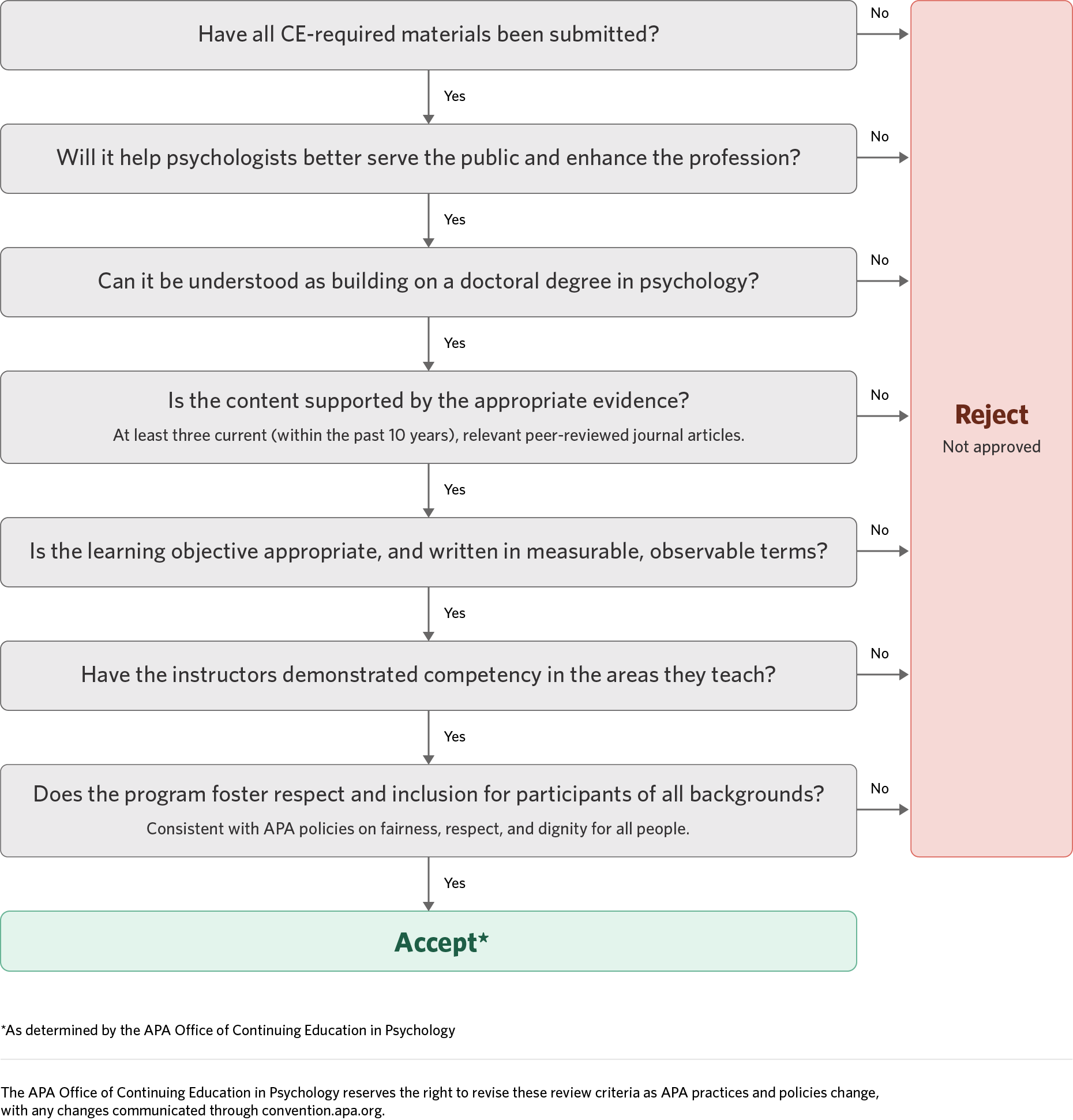
Common reasons why CE applications are rejected and how to avoid them
Reason for Rejection
How to Avoid this Rejection
Application is incomplete.
Submit all the CE application materials listed above, including Instructor Qualifications for each presenter.
Session is intended for graduate students or the general public.
Make sure session content is building on a doctoral degree in psychology.
Session does not adequately establish the evidence-based foundations of the proposed content.
Provide at least three current, relevant, peer-reviewed references.
References are dated.
Provide references within the past 10 years.
Learning objectives are not written in measurable, observable terms.
Write learning objectives with the leading sentence “Based on the content of this session, participants will be able to” and use suggested action verbs, avoiding verbs like ‘learn’ and ‘understand.’
Session is on an interesting or timely topic, but is not grounded in evidence.
Provide at least three current, relevant, peer-reviewed references. The further your topic is from core disciplinary knowledge, the more you need to explain, with evidence, how it is appropriate for CE.
Instructor(s) have not demonstrated competency in the areas they teach.
Instructor qualifications demonstrate expertise through relevant educational background, teaching experience, and publications. Each presenter in the session must complete the instructor qualifications in full.
All session presenters are graduate students.
Given that CE is building on a doctoral degree in psychology, typically at least one presenter holds a doctoral degree.
Questions? Contact us.
Email
cpe@apa.org.
Why Submit Your Session for CE Eligibility?
Boost your CV.
CE presenter are a select group charged with providing high-quality educational programming to attendees.
Help attendees.
Many attendees need to earn CE credits each year to meet their continuing education goals and licensing standards.
Increase visibility.
CE-eligible sessions are highlighted in the Convention program.
IMPORTANT! ALL presenters and program participants—members, nonmembers, and students—are required to register and pay the appropriate registration fees for APA 2027. Registration will open in April. We look forward to seeing you in San Francisco, CA, or virtually!
The Call for Proposals closed at 5 p.m. ET, January 14, 2025.
APA 2025 will feature four different session types: Critical Conversations, Flash Talks, Skill-Building Sessions, or Symposia. Learn more about each session type below.
For additional division-specific information and program chairperson contact details, click
here.